I produced a range of designs, and I looked to get feedback from members of my target audience. I performed a questionnaire with 10 people to see what newspaper design they mostly prefer, and I combined this data from my three video interviews
Comments from respondents on newspaper design:
One of the respondents said how he likes both designs B and C, but his final choice was C. This was because he felt because I was producing a local paper that is mainly informative, B was very bright and stood out but it looked like a tabloid. However, idea C looked like it fitted the paper due to its simplistic design.
Two respondents suggested idea D, because they felt the blue colour of the 'Echo' would make it original and creative, seeing as most newspapers use a red colour scheme.
Several respondents, who picked ideas A and B, liked those designs because the red background allows them to stand out.
Idea E was criticized by one respondent, because they felt the drawing of a pencil within the design ruined the design, so they were drawn away from that idea. They chose idea F, because it was a simple design, and they felt it would make it seem like a newspaper to have this.
Final Masthead:
Although both ideas B and D were equally as popular, I will choose IDEA D. This is because I like the idea of using a simple logo that uses a bit of colour to draw readers in. My newspaper will not be a tabloid, and will be highly informative, so I will not use idea B, due to the red-top design style used.
This design, I will pitch to a focus group, and receive their opinions. From here, I can make any final alterations before progressing to producing my main task.
This is my interview with Liam, who gives me his ideas for a suitable newspaper name and a basic masthead design.
From these interview, I will compile the research together from the interviews, and the questionnaires I did earlier, to choose a final name and design from a masthead.
This is my interview with Mason. In the interview, Mason gives me his thoughts on what would be a most suitable newspaper title, and a design for a masthead.
Mastheads are used to signal the title of the newspaper, as I wrote about previously. Following my questionnaire into my newspaper name, I learned my popular names were Hedingham Echo, and Hedingham Herald. I looked at mastheads into UK newspapers, and drew a series of ideas based on the research I performed.
I will now pitch these ideas to several individuals, and see which name and designs are most popular. I will use this to choose my final newspaper name, and a basic design for a final masthead.
Ideas A and B are based on red-top tabloid newspaper, ideas C and D are based on several local newspapers in my area, while ideas E and F are based on broadsheet and non-red top tabloid newspapers. I have included these different design ideas, because some local newspapers use different styles, compared to others. The Halstead Gazette uses a style similar to Idea C, the Liverpool Echo uses a style similar to Idea A, while the East Anglian Daily Times uses a design similar to Idea F. This shows that mastheads can vary from paper to paper.
Some early thoughts of target audiences members to discover how they felt mastheads should look like.
My feedback showed that my masthead should be creative, so a customer will be drawn to buy it. An 'open' design to make it stand out, with some bright, vibrant colours. A drawing or icon could be included to help make it stand out. 'Eye-catching' designs could be suitable for my newspaper.
What is a masthead? Also known as the ‘nameplate’, it is the
top piece of the newspaper that includes the title of a newspaper, and details
of the newspaper, such as newspaper price, issue number, slogan or a website
address. Mastheads have basic designs, with little colour and imagery included
in them.
National Newspapers:
The Daily Mail includes a simple black and white design,
with a styled font for the logo, and a simple font displaying the price, date
and website. There is also a logo separating the words, which could be used for
identification.
However, The Sun is a lot more colourful, with the title in
bold white text, with a red background. It includes the date, website and
slogan in a simple white text, while the price is much more visible. In
comparison to the Daily Mail, the red box and large text makes the paper stand
out more. This style is replicated in other papers, such as the Daily Star and
Daily Mirror, which are examples of Red-top Newspapers.
Local Newspapers:
In comparison, the Suffolk Free Press has a horizontal grey
bar with gives the price, date and website address, as well as information on
social media accounts. The title is written in a styled blue font, with ‘Suffolk’
written in a smaller, black font.
The Halstead Gazette has a simple masthead. Gazette is seen
in a red text, while Halstead is seen in a smaller black text, like the Suffolk
Free Press. The date, website and price are visible in black text, with the
slogan in a red text – which stands out.
The masthead of the East Anglian Daily Times is very similar
to the Daily Mail, in terms of design. It has a simple black font for the title
of the paper: East Anglian is written larger than Daily Times. The website and
a slogan is included in orange text. Below that is a grey bar featuring the
issue date, issue number and price.
Most local newspapers I researched appear to separate the
circulation area from the title. The area always tends to be on the top of the
masthead. This could show that the publishers are trying to emphasise that the
newspaper is aimed at a certain area. Mastheads in local newspapers may also
include advertisements aimed at a certain area.
Conclusion: Mastheads can be used to identify newspapers,
and have a simple design, with little colour and little imagery. Local
newspapers tend to include more content, including issue numbers and slogans,
within their mastheads.
My research has revealed that the most popular choice for a newspaper name is the 'Hedingham Echo'. This will be my newspaper name.
My questionnaire results, where I surveyed ten people, showed that Hedingham Echo had five votes, while Hedingham Herald had two votes. 'Hedingham Mail', 'Hedingham Free Press' and 'Hedingham Gazette' were also chosen for names.
However, I performed some video questionnaires with members of my target audience to see what they opinions are:
- Hedingham Observer
- Hedingham Free Press
- Hedingham Echo
I could see from this that although it was only picked once, it still proved to show that the Hedingham Echo name is the most popular, so this will be my newspaper name.
I produced a questionnaire, with a list of newspaper names, to see what name people would be most interested in. This would form basic research into what my chosen name will be.
I asked ten people to respond to my questionnaire. Seven males and three females responded.
The majority of the participants I chose were ages 16-20. This is because I wanted to aim my newspaper at a young audience, to get them interested in reading newspapers. Half of the responses said they were 16-20 years old. 3 people were aged 21-30, while there were two people older than 31.
In terms of the name, half of the participants suggested the name of the Hedingham Echo. This could be good because it sounds original, and is easy to remember. The second most popular name was Hedingham Herald. This could be good for alliteration. Other chosen names included The Hedingham Mail, Hedingham Free Press and Hedingham Gazette. I may not choose Hedingham Free Press, or Hedingham Gazette, because other local newspapers use this name.
I decided to create a questionnaire to help me decide what the title of my newspaper should be. I used my original ideas from my previous blog post, and compiled them in a form of a questionnaire. I asked my 'target audience' which name would be most suitable. Below is a blank example of the questionnaire.
These are ideas that I have chosen for newspaper names. These ideas have been created by researching into current local newspaper names and incorporating the 'end names' into my name. I have replaced the location with the location of my newspaper. For example, I have changed the name of the Rochdale Observer (based in Rochdale, Manchester), to the Hedingham Observer. Or the Oxford Mail into the Hedingham Mail. All of these end names have some linkage to delivering information to a person, and informing them.
This video asks several people who they felt the target audience of newspapers are.
I have learned that a variety of people would buy a local newspaper. Mainly, residents in the community will buy the newspaper to analyse what is going on. People from outside the community may also purchase it, to learn about the area. Older aged people may most likely purchase a newspaper.
In this post, I will be performing research into audience theory, and talk about a range of theories that can relate to my newspaper. I may use some of this information to help me in my exam.
A target audience is a specific group of people who a product is aimed at. The target audience of a newspaper will vary depending on the content and news articles within a newspaper. The structure, language and opinions of the newspaper will also affect the audience. Different strategies could also be used to market the newspaper. Tabloids and Broadsheet newspapers have a national audience, and they will target the newspaper at a larger demographic, compared to a local newspaper, which will be aimed at a much smaller audience.
There are three major theories used in the media, to perform research that allows the target audience to get involved:
The Hypodermic Syringe Model
2-Step Flow Model
Uses And Gratification Theory
The Hypodermic Syringe Model (also known as the Hypodermic Needle Model) suggests that the media can influence an audience, that was introduced in the 1920's. The theory suggests that an audience can be manipulated through media. Newspapers can be very opinionated, meaning the public can be highly influenced by the media. This is because newspapers, mainly tabloids (such as The Sun), tend to 'spin' stories, and sometimes make a big deal out of a small event. This was developed by Frankfurt School, who said that "media injects a message into the audience". This theory mainly perceives the audience to be passive. A limit to this theory is that the audience can be more aware of these messages that are injected into the audience.
The Two-Step Flow Model is when information from the mass media is passed on to a group of opinion leaders, who then share that information with individuals in the public. These 'opinion leaders' can be influential on the 'individuals' and the media. Newspapers can act as Opinion Leaders, because they receive information for news articles from the mass media, and then this information is forwarded to the public (the individuals). This was developed by Katz and Lazarfield. This moves on from the Hypodermic Syringe Model because it does not just think of the audience as passive consumers. A limitation to this theory is that it is biased/very opinionated, which could mean the model will influence people.
The Uses and Gratifications Theory is a theory used which is more focused on the consumer, and focused on 'what media do with media', rather than 'what the media does to the audience'. The theory suggests that people are responsible for choosing their own media. The internet has played a large part in this theory, where the internet allows us to identify and find new items ourselves. However, this is criticized, because many people feel the public have no control over what the media produces. The reasons for media use include Education, Entertainment, Social interaction and Identification. This was developed by Katz and Blumler in 1974, and expanded by McQuail in 1987. They said that people sought out media products to fulfil needs and desires. This theory is controlled by the audience.
Needs/Desires
Identify: Find reinforcements for personal values/find role models
Educate: Find out events, seek advice
Entertain: Escape/divert from problems, emotional release
Interact: Social interaction, basis for conversation, sense of belonging
How can I use these theories in my newspaper?
My newspaper will be aimed at a certain target audience - a range of people based in the village of Sible Hedingham. With these three theories, they all suggest that media influences the opinions of people. My newspaper will include stories which may have had an affect on the area and I will voice a small opinion on the articles, in case readers are influenced by what is said in my newspaper. I can conclude from this that I should not 'spin' stories, or include fictional information, in case people are influenced by the newspaper.
The Hypodermic Syringe Model will be relevant to my coursework, because newspapers will make the audience feel a certain way about an article.
The two-step flow theory will be relevant to my coursework because it will be a way of transferring information to the audience (readers).
The uses and gratifications theory will be relevant to my film because it will educate people in what is going on, and allow others to interact (social interaction).
I performed a questionnaire to learn why people read local newspapers. The results helped me learn that local news and sport is a highly read feature within local newspapers. I can conclude that I should include local news and sport within my final newspaper coursework.
To investigate further into research of target audience for my coursework, I performed a questionnaire on an audience, to decide why people read newspapers, and what would attract them to read newspapers more. Included below are six responses that I received for my 'target audience' questionnaire.
In my next post, I will conclude the feedback included, talking about what I have learned from this.
To investigate further into research of target audiences, I have decided to create a questionnaire to help me learn more about readers of newspaper. This could help me decide what content I include in my final coursework piece. After I receive back a series of results, I can then conclude on who my target audience will be for my newspaper. Receiving feedback from this could also give me some ideas on what my newspaper title, and articles could be about. This questionnaire I will give out to a range of members in the public, varying from young males, to older females.
Many newspaper companies incorporate a colour scheme into their newspaper products to help show a link between products. The newspaper, website, and billboards will all use the same colour scheme.
Product 1: The Sun (click image to enlarge)
Products dated: Jan 2nd, 2016.
Newspaper
Website
Product 2: The Daily Mail (click image to enlarge):
Products dated: Jan 2nd, 2016.
In this newspaper, I will be looking into three existing types of newspapers, and discovering the comparisons between them.
To conclude, all three different "types" of newspapers produce different content. The three different types of newspapers can voice their different opinions towards articles, to make all newspapers different. Opinions within newspapers can be seen, mainly for political reasons, which could cause different people to purchase these newspapers, meaning the different newspapers can get different audiences.
The aim of a newspaper is to inform readers about current affairs, written as ‘articles’.
An article includes the following:
Headlines summarize the article in a small sentence. This will be seen in large bold text, which could interest the reader. This can either be serious, or humorous, depending on the newspaper or article. The Sun, a tabloid, may include a joke or pun within the headline, while The Telegraph, a broadsheet, may have a serious headline. Some headlines include quotes from, or the opinion of a person. Other headlines may include alliteration. Headlines are sometimes written fully in capital letters, while others use little capital letters. This could be because they want the reader to be drawn to certain articles, which could be more informative, compared to other articles. These will be written in large, bold text.
Sub-headers, will expand on the headline in more detail, and will give a brief explanation about what is occurring. These will be below the headline, in a smaller sized font, and is sometimes underlined.
The Main body is where the main article is written. Written in paragraphs, the body opens with a sentence or two, which introduces the article for the reader. These are written in past tense, unless they are stating something that will occur in the future. The first word in the article of most articles is written in capital letters. This could be used to draw attention to the start of the article.
Photographs, which are usually included in most articles. They are relevant to the article (e.g. a person involved, a place of where an event occurred)
A Caption will be included below the photograph, to describe what is in the photograph. It may also give the reader more information about the event.
Newspaper articles are usually written in columns, which is used to structure the newspaper.
What else is included within newspapers? Mastheads are the headers of newspaper front pages. These tell the reader information such as the newspaper name, price and the issue date. Advertisements for companies and products are also included within newspapers, either taking up a section of a page, or sometimes take up a full page, allow readers to find products which they might be looking to purchase. Interactive reader features, such as reader letters, allow readers to voice their opinion or search for advice on a topic. These allow readers to contribute their voice and get involved in the newspaper.
Pages dedicated to housing, job, vehicle and theatre listings are included in newspapers, mainly local newspapers, to allow people to find items.
Audience Research:
Articles, advertisements, celebrity news, local news (e.g. fete/carnival), and large images and headline, with a taster of an article would attract the attention of people if they purchased a newspaper. Including all these conventions would follow the main features of a newspaper. Some of these features I would expect to include in a newspaper. However, I would not expect celebrity news to be featured within a local newspaper, as that type of news does not usually affect a local area.
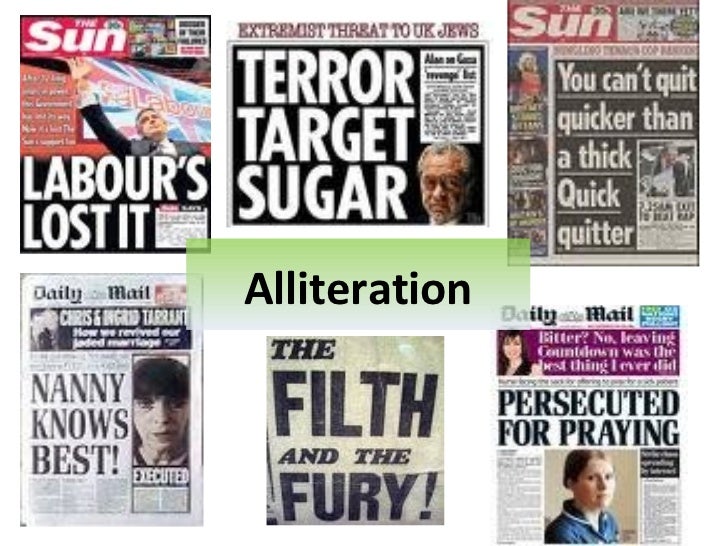
Headlines are often short and straight to the point. They use small words in a way to make an impact to the audience to grab their attention. Strong words can be used such as 'Trolls' or 'Thugs' to help emphasis a story too. Some articles use a 'play-on-words' to help draw in the attention of a reader, or use puns to draw the attention (seen in The Sun example above). Some article headlines use alliteration, where an article uses words that begin with the same letter, or words that sound similar. Examples below include "Terror Target Sugar", and "Labour's Lost It". This means it can be memorable for readers, meaning they can then pass this information on to others.
Audience Research:
A large, short&snappy headline that is eye-catching would be what people expect in a newspaper deadline.
Examples of Headlines in Local Papers:
Local newspapers include a range of headlines that summarizes an article. Examples of current headlines that feature in the Halstead Gazette include the following:
Town's property prices rose 10% during 2015
This article focuses on property prices during the previous year, and includes a statistic to back-up the point.
Colchester Stagecoach students wow the West End
This article focuses on a group of students performing a theater event, which was positively praised. Alliteration is included with 'wow the West End', while the name of the people involved has been included, to make it focused on them.
Women assaulted in Halstead
This article focuses on an assault in a local town. The headline is short and snappy, meaning it could be easy to remember.
Hundreds turn out to see Boxing Day hunt
This article focuses on a village's Boxing Day tradition working with a horse hunt group. 'Hundreds' is written in the article to include a statistic to show how many people attended.
From this, I can conclude most of these headlines are short and snappy, while statistics are included in some. I will use this as inspiration for my headlines which I will use in my final task.